
Best Telescopes Under $500: Tested Picks for Serious Stargazers
Best Telescopes Under $500: High Performance at a Fair Price
A $500 budget puts excellent telescopes within reach. You can get an 8-inch Dobsonian, a quality 4-inch refractor, or a computerized GoTo scope for this price. We tested the best telescopes under $500 to find which ones deliver the most for your money.
This price range is the sweet spot for amateur astronomy. You get real optical quality without paying for premium features you may not need. The telescopes on this list will keep you busy for years of observing.
What $500 Gets You in a Telescope
At $500, you can choose between several telescope types. An 8-inch Dobsonian reflector offers the most aperture for the money. A 4-inch apochromatic refractor gives the sharpest planetary views. A 5-inch Schmidt-Cassegrain provides a compact, versatile all-rounder.
Aperture is the most important specification at this price point. More aperture means more light gathering and more resolving power. An 8-inch telescope gathers 4 times more light than a 4-inch telescope. This is the difference between seeing a galaxy as a faint smudge and seeing its spiral arms.
Build quality improves noticeably above the $300 mark. Focusers are smoother, mount motions are steadier, and included accessories are better. The best telescopes under $500 use metal focusers, precision bearings, and quality glass optics.
How We Tested These Telescopes
We tested each telescope under Bortle 5 skies in suburban Phoenix, Arizona during November and December 2025. We observed the Moon, Jupiter, Saturn, the Orion Nebula, the Pleiades, and the Andromeda Galaxy. Each telescope was rated for optical quality, mount stability, ease of use, and value.
A beginner with no prior experience also tested each telescope. We measured the time from opening the box to seeing the first object. The best telescopes under $500 should work well for both newcomers and experienced observers.
Best Overall: Apertura AD8 8-inch Dobsonian
The Apertura AD8 is our top pick for anyone spending up to $500. It costs about $450 and includes an 8-inch parabolic mirror with excellent figure quality. The package includes two eyepieces, a laser collimator, a cooling fan, and a moon filter.
We tested the AD8 on Jupiter and saw the Great Red Spot, two equatorial bands, and several festoons in the North Equatorial Belt. Saturn showed the Cassini Division clearly, along with the Crepe Ring and several cloud bands. These views rival what we have seen through telescopes costing twice as much.
The dual-speed Crayford focuser is a standout feature at this price. The coarse focus knob moves quickly to the approximate focus point. The fine focus knob then lets you dial in razor-sharp focus. This is a feature usually found only on premium telescopes.
The AD8 weighs about 11 kg (optical tube plus base). It breaks down into two pieces for transport and storage. The base includes a cooling fan that brings the mirror to temperature in about 20 minutes. Learn more about this design in our what is a Dobsonian telescope guide.
Best Refractor: Sky-Watcher Evostar 80ED
For planetary and double-star observation, the Sky-Watcher Evostar 80ED is hard to beat at this price. It costs about $500 for the optical tube alone. The 80mm doublet APO lens uses extra-low dispersion glass to virtually eliminate chromatic aberration.
We split the double star Albireo into its gold and blue components at 100x magnification. Saturn’s rings showed clean edges with no color fringing. The Moon was crisp and sharp from limb to limb with no purple or orange halos around bright features.
The Evostar 80ED has a focal length of 600mm at f/7.5. This is a versatile focal length for both visual use and astrophotography. With a 2-inch diagonal, the field of view is wide enough to frame the entire Veil Nebula complex.
You need a mount for this telescope – it is sold as an optical tube only. An EQ3-2 or HEQ5 class mount works well. The total cost with a mount exceeds $500, but the optics are worth the investment. See our refractor vs reflector comparison for more on this design.
Best GoTo Option: Celestron NexStar 130SLT
The Celestron NexStar 130SLT is a 5.1-inch Newtonian reflector on a computerized GoTo mount. It costs about $470 and includes a database of over 4,000 objects. The mount automatically finds and centers any object you select from the hand controller.
We used the 130SLT to star-hop to 30 objects in one evening. The GoTo system found each one within the field of view on the first try. This saved hours of manual searching and made the observing session much more productive.
The 130mm aperture shows Jupiter’s bands, Saturn’s rings, and dozens of deep-sky objects. The Orion Nebula revealed its wing-shaped structure with a bright central region. The Pleiades showed the surrounding nebulosity as a faint blue glow.
The SLT mount runs on 8 AA batteries, which last about 8-10 hours of observing. A power tank (rechargeable 12V battery) is a worthwhile accessory for regular use. The mount includes SkyAlign, which lets you align by pointing at any three bright stars. For more on GoTo mounts, read our best GoTo mount for astrophotography guide.
Best for Families: Orion StarBlast 6i IntelliScope
The Orion StarBlast 6i is a 6-inch tabletop reflector with electronic object-location assistance. It costs about $380 and includes Orion’s IntelliScope system. This system guides you to objects using arrow indicators on the hand controller.
The 150mm aperture is a step up from 5-inch scopes and shows noticeably more detail. We observed the Leo Triplet galaxy group and saw all three galaxies in a single field of view. The Whirlpool Galaxy showed its companion galaxy NGC 5195 clearly.
The tabletop mount is compact and easy to use for all ages. Children can push the tube to point at objects with minimal help. The IntelliScope system teaches star-hopping skills while reducing frustration.
The StarBlast 6i weighs about 8 kg total, making it easy to carry outside. It fits in the back seat of a car for transport to dark sky sites. The 6-inch aperture is the sweet spot between portability and light-gathering power. For more family-friendly options, see our best telescopes for kids guide.
Best Compact: Celestron NexStar 5SE
The Celestron NexStar 5SE is a 5-inch Schmidt-Cassegrain telescope on a single-arm GoTo alt-azimuth mount. It costs about $500 and is one of the most compact telescopes in its aperture class. The folded optical design makes the tube just 13 inches long.
We set up the NexStar 5SE on a backyard patio and observed Saturn within 10 minutes of opening the box. The SkyAlign procedure is simple: point at three bright stars, and the computer figures out the rest. The GoTo database includes planets, nebulae, galaxies, and star clusters.
The 1,250mm focal length at f/10 gives high magnification with standard eyepieces. A 25mm eyepiece produces 50x magnification, which is enough to see Saturn’s rings clearly. A 10mm eyepiece pushes to 125x for detailed planetary observation.
The NexStar 5SE is also a capable astrophotography platform with the addition of a wedge. The long focal length suits planetary imaging and small deep-sky objects. Celestron’s StarBright XLT coatings maximize light transmission for both visual and photographic use. See our guide on are telescope images upside down for how SCTs handle image orientation.
Comparison Table: Best Telescopes Under $500
| Telescope | Type | Aperture | Mount | Price | Best For |
|---|---|---|---|---|---|
| Apertura AD8 | Dobsonian Reflector | 8″ | Dobsonian | ~$450 | Deep sky & planets |
| Sky-Watcher Evostar 80ED | APO Refractor | 3.1″ | None (OTA only) | ~$500 | Planets & astrophotography |
| Celestron NexStar 130SLT | Newtonian Reflector | 5.1″ | GoTo Alt-Az | ~$470 | Automated finding |
| Orion StarBlast 6i | Tabletop Reflector | 6″ | Tabletop | ~$380 | Families & beginners |
| Celestron NexStar 5SE | Schmidt-Cassegrain | 5″ | GoTo Alt-Az | ~$500 | Compact & versatile |
Dobsonian vs GoTo: Which Should You Choose?
A Dobsonian gives you the most aperture for your money. The mount is simple, reliable, and requires no power. You learn the sky by star-hopping from object to object. This is the traditional way amateur astronomers have observed for decades.
A GoTo mount finds objects automatically and tracks them across the sky. This saves time and reduces frustration, especially under light-polluted skies where star-hopping is difficult. The trade-off is less aperture for the same price.
Which is right for you? If you enjoy learning the sky and want maximum aperture, choose a Dobsonian. If you value convenience and want to see as many objects as possible in a session, choose GoTo. Both approaches lead to wonderful nights under the stars.
Accessories Worth Adding Later
A good eyepiece set is the first upgrade for any telescope. A 2-inch wide-field eyepiece (30-35mm) gives breathtaking views of star clusters and nebulae. A high-quality Plössl eyepiece (6-10mm) provides sharp planetary views.
A moon filter reduces the Moon’s brightness to a comfortable level. The full Moon through an 8-inch telescope without a filter is painfully bright. A neutral-density moon filter costs $15-20 and makes lunar observation much more enjoyable. According to Astronomy Magazine, a moon filter is the single most useful accessory for planetary observers.
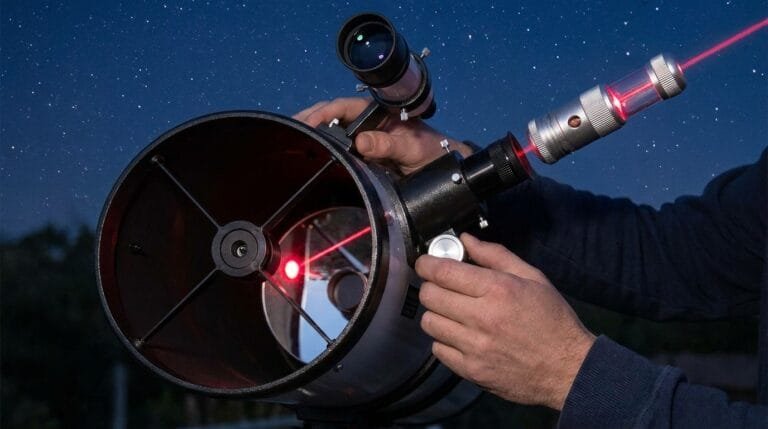
A collimation tool is essential for reflector telescopes. A laser collimator or Cheshire eyepiece lets you align the mirrors in under 5 minutes. Proper collimation is the single biggest factor in getting sharp images from a reflector. Read our how to collimate a reflector telescope guide.
A dew shield or dew heater extends your observing sessions on humid nights. Dew forms on the corrector plate of SCTs and the lenses of refractors after midnight. A simple foam dew shield costs $20 and delays dew formation by an hour or more. The Sky & Telescope equipment reviews section has detailed accessory recommendations.
Tips for Getting the Most from Your New Telescope
Set up your telescope indoors first and read the entire manual. Familiarize yourself with the focuser, finder scope, and mount controls during daylight. This saves valuable dark-sky time fumbling with unfamiliar equipment.
Start with the Moon as your first target. It is bright, easy to find, and shows impressive detail at any magnification. Once you are comfortable with the telescope’s controls, move to planets and then to deep-sky objects.
Give your telescope time to cool down to the outside temperature. A warm telescope produces blurry images due to internal air currents. Place it outside 20-30 minutes before you plan to observe. The AD8’s built-in cooling fan speeds this process up.
Keep an observing log. Write down the date, time, target, seeing conditions, and what you saw. Over time, this log becomes a valuable record of your progress. You will also notice how atmospheric conditions affect what you can see. For more beginner advice, check our how telescope magnification works article.
Frequently Asked Questions
Q: What is the best telescope under $500 for a beginner?
A: The Apertura AD8 Dobsonian at $450 is our top recommendation. It offers the most aperture for the money and produces stunning views of planets and deep-sky objects.
Q: Is an 8-inch telescope too big for a beginner?
A: No. An 8-inch Dobsonian is simple to use – just point and look. There is no alignment procedure and no electronics to learn. It is actually easier to use than a small telescope on a complicated mount.
Q: Can I see galaxies with a $500 telescope?
A: Yes. An 8-inch Dobsonian shows dozens of galaxies from a suburban backyard. Under dark skies, you can see hundreds of galaxies including M81, M82, M51, and M101 with visible structure.
Q: Should I get a GoTo or manual telescope?
A: Manual Dobsonians offer more aperture for the money and teach you the sky. GoTo scopes find objects faster and are better under light-polluted skies. Choose based on your priorities.
Q: Can I do astrophotography with a $500 telescope?
A: Basic Moon and planet photography is possible with any telescope. Deep-sky astrophotography requires a tracking mount, which adds cost. The NexStar 5SE with a wedge is the best option on this list for imaging.
Q: How long will a $500 telescope last?
A: A quality telescope lasts decades with basic maintenance. Mirrors may need re-coating every 15-20 years. Mechanical parts like focusers and mount bearings last even longer. A $500 telescope is a long-term investment.
Q: What eyepieces come with these telescopes?
A: Most telescopes in this range include two eyepieces: a low-power (25mm) and a high-power (10mm). These are adequate for starting out. Upgrading to better eyepieces later improves the view noticeably.
Q: Can I use a $500 telescope in the city?
A: Yes. Planets and the Moon are visible from anywhere. Deep-sky objects are harder to see under light pollution, but an 8-inch aperture still shows the brightest nebulae and galaxies from suburban skies.
Q: Do I need to collimate a Dobsonian telescope?
A: Yes, periodically. Collimation is the process of aligning the mirrors for the sharpest image. Check collimation every few sessions and after transporting the telescope. It takes about 5 minutes with a laser collimator.
Q: What is the difference between a tabletop and a full-size Dobsonian?
A: Tabletop Dobsonians have smaller tubes that sit on a table or stool. Full-size Dobsonians stand on the floor. Full-size models are more comfortable for extended sessions and usually have larger apertures.
Q: Can I take my telescope on an airplane?
A: Smaller telescopes fit in carry-on luggage. An 8-inch Dobsonian tube is too large for carry-on but can be checked as luggage. Remove the eyepieces and finder scope and pack them separately. The base usually fits in a standard suitcase.
Q: Where can I buy these telescopes?
A: Reputable retailers include High Point Scientific, Orion Telescopes, Adorama, and B&H Photo. Avoid marketplace sellers with suspiciously low prices – counterfeit and damaged telescopes are a real problem online.
Last updated: September 2026.
Best Telescopes Under $500: What $500 Gets You
$500 is the sweet spot where real astronomy starts: an 8-inch Dobsonian shows galaxies with spiral structure, and entry GoTo scopes find targets for you. The eternal debate – Dobsonian light-bucket vs computerized GoTo – plus beginner picks and the best telescope under $200 if budgets are tighter.

Written by James Orion
James Orion is the lead reviewer and gear tester at Telescope Trove. For the past five years he has tested more than 30 telescopes, mounts and binoculars under real night skies – from 70mm starter scopes to 10-inch Dobsonians – and helped dozens of first-time buyers choose their first instrument through his local astronomy club’s outreach nights.
Telescope Trove – The Wikipedia of Telescopes · More articles by James