What Is a Dobsonian Telescope? A Complete Beginner’s Guide
Introduction
If you’re just getting into astronomy, you’ve likely heard about Dobsonian telescopes. Experienced stargazers often call them the best starter scope for a reason. They’re simple, powerful, and don’t cost a fortune.
A Dobsonian telescope stands out because of its straightforward design, great value for money, and ability to pull in tons of light from the night sky. Unlike fancy telescopes with complex tracking systems and heavy mounts, a Dobsonian keeps things practical so you can focus on actually enjoying the stars instead of fighting with equipment.
In this guide, I’ll explain what a Dobsonian really is, how it works, its pros and cons, and whether it makes sense for you as a beginner.
What Is a Dobsonian Telescope?
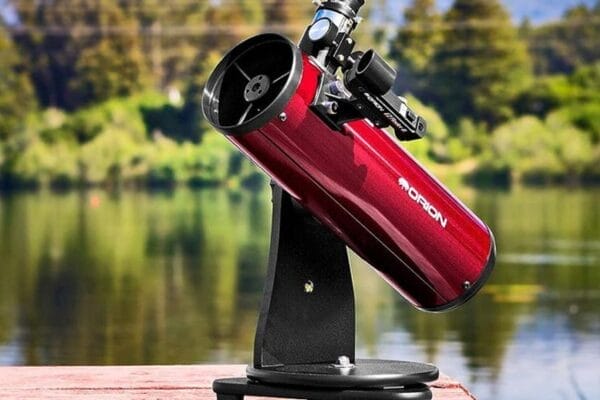
A Dobsonian is a type of reflecting telescope that uses a big primary mirror to collect light. It sits on a simple, smooth-moving wooden or metal base (called an alt-azimuth mount) that lets you easily point it up and down or side to side.
John Dobson created this design to make big telescopes affordable and user-friendly for regular people. By skipping expensive equatorial mounts and electronics, most of your money goes straight into the optics meaning you get a much bigger mirror for the same price.
How Does a Dobsonian Telescope Work?
It’s pretty simple. Light from space enters the open end of the tube and hits a large curved primary mirror at the bottom. That mirror reflects and focuses the light onto a smaller secondary mirror, which then bounces it out through the focuser and into the eyepiece.
The bigger the mirror (aperture), the more light it gathers which means you can see fainter and more distant objects with better detail.
Main Parts of a Dobsonian Telescope
Here’s what you’ll usually find on a typical Dobsonian:
- Optical Tube: The main body that holds everything.
- Primary Mirror: The large mirror at the bottom that collects light.
- Secondary Mirror: The smaller flat mirror that redirects light to the eyepiece.
- Focuser: Where you attach eyepieces and fine-tune the focus.
- Eyepiece: The part you actually look through.
- Finder Scope / Red Dot Finder: Helps you quickly locate objects in the sky.
- Alt-Azimuth Mount: Simple, smooth base that moves in altitude and azimuth (left/right).
- Base: A sturdy platform that keeps the telescope stable.
Why Are Dobsonian Telescopes So Popular?
Dobsonians have become a favorite among amateur astronomers because they deliver serious performance without unnecessary complications. Key reasons include:
- Huge light-gathering power for the price
- Super easy to set up and use
- Outstanding value more aperture for your money
- Smooth and stable movement
- Very little maintenance required
- Excellent for viewing deep-sky objects
- Perfect for beginners
Advantages of a Dobsonian Telescope
Excellent Light Gathering
A large mirror lets you see dim nebulae, galaxies, and star clusters that smaller scopes simply can’t show clearly.
Great Value
You get way more aperture (mirror size) compared to other telescope types at the same price point.
Beginner-Friendly
No complicated setup or alignment needed. Just point and observe.
Stable and Smooth
The solid base reduces vibrations, so the view stays steady.
Best for Visual Observing
They shine when it comes to visual stargazing, especially under dark skies.
Disadvantages of a Dobsonian Telescope
Like any telescope, they aren’t perfect:
- Size: Larger models can be bulky and need decent storage space.
- Manual Tracking: You have to move the scope yourself as objects drift across the sky.
- Not Great for Astrophotography: They work for casual Moon shots but aren’t ideal for long-exposure deep-sky photos.
- Transport: Big Dobsonians can be heavy and awkward to carry to dark-sky sites.
What Can You See With a Dobsonian Telescope?
With a good Dobsonian, you can enjoy amazing views of:
- Detailed craters, mountains, and valleys on the Moon
- Jupiter’s cloud bands and its moons
- Saturn’s beautiful rings
- Mars (when it’s close to Earth)
- Venus going through phases
- Bright nebulae and star-forming regions
- Open and globular star clusters
- Distant galaxies (like Andromeda)
- Beautiful double stars
The darker your observing location, the more breathtaking these objects become.
Dobsonian vs Refractor Telescope
| Feature | Dobsonian | Refractor |
| Optical Design | Reflector (mirrors) | Lens-based |
| Best For | Deep-sky objects | Moon and planets |
| Maintenance | Occasional collimation | Very low |
| Price (for aperture) | Much more affordable | More expensive |
| Portability | Medium to large | Usually compact |
Dobsonian vs Schmidt-Cassegrain Telescope
| Feature | Dobsonian | Schmidt-Cassegrain |
| Cost | More affordable | More expensive |
| Ease of Use | Very simple | Moderate |
| Astrophotography | Limited | Excellent with gear |
| Visual Observing | Outstanding | Excellent |
| Maintenance | Moderate | Moderate |
Is a Dobsonian Telescope Good for Beginners?
Yes .it’s one of the best choices for new astronomers.
Instead of getting frustrated with complicated equipment, you can spend your time actually looking at the sky. Many astronomy clubs and experienced observers strongly recommend starting with a Dobsonian because it’s forgiving, fun, and gives impressive results right away.
Tips for Using a Dobsonian Telescope
- Observe from the darkest location possible
- Give the telescope 30 To 60 minutes to cool down to outside temperature
- Clean the mirrors only when really necessary
- Learn “star hopping” to find objects
- Invest in a few good quality eyepieces
- Store it in a dry, safe place
These small habits make a big difference in image quality and how long your telescope lasts.
Frequently Asked Questions
Is a Dobsonian better than a refractor?
It depends on what you want to see. Dobsonians are generally better for deep-sky objects (nebulae, galaxies, clusters) because of their larger aperture. Refractors often perform better on bright targets like the Moon and planets.
Can beginners use a Dobsonian?
Absolutely. Its simple design makes it one of the easiest telescopes to learn and enjoy.
Do Dobsonian telescopes need electricity?
Traditional ones don’t need any power at all. Only computerized “GoTo” versions use batteries.
Can you see galaxies with a Dobsonian?
Yes! Even a medium-sized Dobsonian can show many galaxies, especially from dark locations.
How much magnification does it give?
It depends on the eyepiece you use. You can change eyepieces to get different levels of magnification.
Final Thoughts
A Dobsonian telescope gives you the perfect mix of powerful optics, simple operation, and excellent value. It strips away the unnecessary complications so you can focus on what really matters exploring the wonders of the night sky.
Whether you’re just starting out or looking for a serious visual scope, a Dobsonian is hard to beat. If your main goal is enjoying the Moon, planets, and deep-sky objects with your own eyes, this is one of the smartest choices you can make. Happy stargazing!
Last updated: September 2026.
What Is a Dobsonian Telescope?
A Dobsonian is a Newtonian reflector on a simple plywood rocker-box mount – no gears, no motors, just smooth push-to motion. That simplicity is why it delivers the most aperture per dollar in astronomy. Deep dive: the ultimate Dobsonian review, refractor vs reflector, and the best telescopes for beginners. Background: Sky & Telescope.

Written by James Orion
James Orion is the lead reviewer and gear tester at Telescope Trove. For the past five years he has tested more than 30 telescopes, mounts and binoculars under real night skies – from 70mm starter scopes to 10-inch Dobsonians – and helped dozens of first-time buyers choose their first instrument through his local astronomy club’s outreach nights.
Telescope Trove – The Wikipedia of Telescopes · More articles by James