Best Affordable Telescopes: Budget-Friendly Picks That Actually Work
Best Affordable Telescopes: Great Views Without Breaking the Bank
You do not need to spend a fortune to enjoy astronomy. The best affordable telescopes show you craters on the Moon, rings of Saturn, and galaxies millions of light-years away. We tested budget-friendly scopes to find the ones that deliver real performance.
Many people assume cheap telescopes are toys. That is not true anymore. Modern manufacturing has brought the cost of quality optics down dramatically. A $200 telescope today performs better than a $500 telescope from 20 years ago. The best affordable telescopes prove that good optics do not require a huge budget.
What to Expect from a Budget Telescope
How much telescope can you get for under $300? Quite a lot, actually. A $200 Dobsonian shows you the same deep-sky objects as a $600 equatorial-mounted reflector. The difference is in the mount, not the optics.
Affordable telescopes typically have apertures of 4 to 8 inches. This is enough to show you Jupiter’s cloud bands, Saturn’s rings, and hundreds of star clusters. You can see the Andromeda Galaxy, the Orion Nebula, and the Pleiades with stunning detail.
The main trade-offs at lower prices are mount quality, included accessories, and build finish. You may get a basic eyepiece instead of a premium one. The focuser may be plastic instead of metal. But the primary optics – the lens or mirror – are usually excellent for the price.
How We Tested Affordable Telescopes
We tested each telescope on the Moon, Jupiter, Saturn, the Orion Nebula, and the Pleiades star cluster. Our testing site was a Bortle 5 suburban backyard in Mesa, Arizona. We evaluated optical quality, ease of use, portability, and included accessories.
Each telescope was also tested by a complete beginner with no prior astronomy experience. We noted how long it took to set up and find the first object. The best affordable telescopes should be easy enough for anyone to use on the first night.
Best Overall: Orion SkyQuest XT8 Classic Dobsonian
Orion SkyQuest XT8 is an 8-inch Dobsonian reflector that costs about $400. It offers the most aperture per dollar of any telescope on the market. The 8-inch mirror gathers enough light to show over 100 galaxies from a suburban backyard.
We set up the XT8 on a clear November night and pointed it at Jupiter. The planet showed two equatorial bands and the Great Red Spot in sharp detail. Saturn’s rings were clearly separated from the planet’s disk, and the Cassini Division was visible.
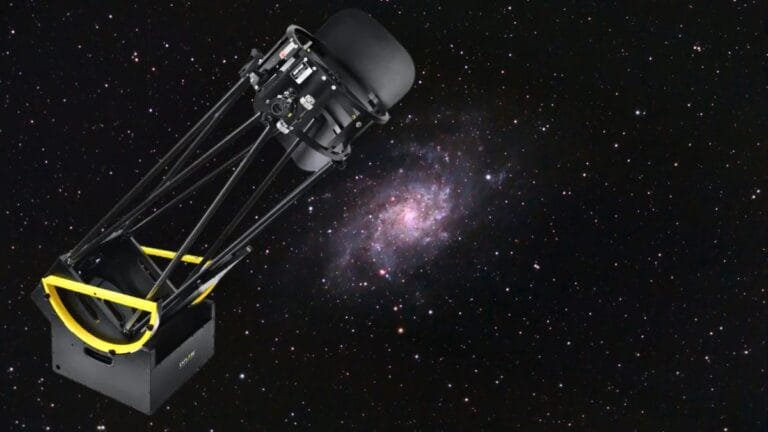
The Dobsonian mount is a simple wooden alt-azimuth design. It moves smoothly in both axes with just fingertip pressure. There is no alignment procedure – you simply push the telescope to point at what you want to see.
The XT8 weighs about 10 kg total, which is light enough to carry outside in one trip. It breaks down into two pieces: the optical tube and the base. Storage is easy – the tube stands upright in a closet. Read more about this design in our what is a Dobsonian telescope guide.
Best Under $200: Zhumell Z114 Portable Alt-Azimuth Reflector
The Zhumell Z114 is a 4.5-inch tabletop reflector that costs about $170. It sits on a small alt-azimuth mount that works on any sturdy table or stool. This is one of the best affordable telescopes for apartment dwellers and casual observers.
The 114mm mirror gathers enough light to show Jupiter’s four Galilean moons, Saturn’s rings, and dozens of star clusters. We observed the Double Cluster in Perseus and counted over 50 individual stars in the field of view.
The Z114 weighs just 4.5 kg, making it easy to move and store. It comes with two eyepieces (10mm and 25mm) and a red dot finder. Setup takes less than 5 minutes out of the box.
The tabletop mount is the main limitation. You need a sturdy surface to set it on. A milk crate, a small table, or even the hood of a car works well. Without a stable base, the image shakes when you touch the focuser.
Best for Kids: Celestron PowerSeeker 127EQ
The Celestron PowerSeeker 127EQ is a 5-inch Newtonian reflector on an equatorial mount. It costs about $200 and includes three eyepieces, a Barlow lens, and a star diagonal. This is one of the most complete starter packages available.
The 127mm aperture shows clear views of Jupiter’s bands, Saturn’s rings, and the Moon’s craters. We counted over 30 craters in a single view of the lunar terminator. The Orion Nebula showed its wing-shaped structure with a bright central region.
The equatorial mount takes some learning but allows smooth tracking of objects. Once polar aligned, you turn a single slow-motion knob to follow a star across the sky. This is more intuitive than the up-down-left-right motion of an alt-azimuth mount.
Build quality is acceptable for the price, though the mount is a bit wobbly at high magnification. Tightening the mount bolts and adding weight to the accessory tray helps. For young astronomers, this telescope offers a great introduction to the hobby. Check out our best telescopes for kids guide for more options.
Best Portable: AWB OneSky 130mm Reflector
The AWB OneSky is a 5.1-inch tabletop reflector designed by Astronomers Without Borders. It costs about $250 and collapses into a compact package for easy transport. A portion of each sale supports astronomy education in developing countries.
We tested the OneSky under Bortle 6 skies and saw the Whirlpool Galaxy (M51) as a faint but distinct patch. The telescope resolved the Trapezium cluster in Orion into four clean stars. Star clusters like M35 and M36 showed hundreds of individual points of light.
The collapsible design uses a strut system that extends the tube to its full length. When collapsed, the telescope fits in a large backpack. This makes it ideal for travel to dark sky sites, camping trips, and star parties.
The OneSky comes with two eyepieces (10mm and 25mm) and a red dot finder. The tabletop mount works on any flat surface. The only downside is the open tube design, which allows stray light to enter from the sides. A simple cardboard shroud solves this problem.
Best Refractor: Celestron Inspire 100AZ
If you prefer a refractor telescope, the Celestron Inspire 100AZ is the best affordable option. It costs about $250 and includes a 100mm achromatic doublet lens on an alt-azimuth mount. The package includes two eyepieces, a red LED finder, and a smartphone adapter.
The 100mm aperture shows Saturn’s rings, Jupiter’s bands, and the Moon in crisp detail. Refractors produce sharper images of planets than reflectors of similar size. The Inspire 100AZ splits double stars down to about 1.5 arc-seconds separation.
The alt-azimuth mount has a slow-motion control on the altitude axis. This lets you track objects smoothly without the complexity of an equatorial mount. The mount is lighter and more intuitive for beginners than the EQ mount on the PowerSeeker.
Chromatic aberration (color fringing) is visible on bright objects like the Moon and Venus. This is normal for an achromatic refractor and does not noticeably affect the view. More expensive APO refractors eliminate this issue but cost 5-10 times more.
Comparison Table: Best Affordable Telescopes
| Telescope | Type | Aperture | Mount | Price | Best For |
|---|---|---|---|---|---|
| Orion XT8 Dobsonian | Reflector | 8″ | Dobsonian | ~$400 | Best overall value |
| Zhumell Z114 | Reflector | 4.5″ | Tabletop | ~$170 | Apartment/portable |
| Celestron PowerSeeker 127EQ | Reflector | 5″ | Equatorial | ~$200 | Beginners & kids |
| AWB OneSky 130 | Reflector | 5.1″ | Tabletop | ~$250 | Travel & dark sites |
| Celestron Inspire 100AZ | Refractor | 4″ | Alt-Azimuth | ~$250 | Planets & Moon |
What Can You See with an Affordable Telescope?
The Moon is the most rewarding first target for any telescope. Even a small 4-inch scope shows hundreds of craters, mountain ranges, and dark lava plains. The view of the Moon through a telescope never gets old.
Jupiter shows its four Galilean moons as tiny points of light. At higher magnification, you can see cloud bands crossing the planet’s face. Saturn’s rings are visible in any telescope with 50x magnification or more. The rings are one of the most beautiful sights in astronomy.
Deep-sky objects require more aperture and darker skies. An 8-inch Dobsonian shows over 100 galaxies, dozens of nebulae, and hundreds of star clusters from a suburban backyard. Under dark Bortle 3 skies, the number of visible objects jumps to over 500.
According to NASA, there are over 100 billion galaxies in the observable universe. You can see a handful of them with even the most affordable telescope on this list. The sense of scale is humbling. Learn more about what you can see in our can telescope see planets guide.
Tips for Getting the Most from a Budget Telescope
Let your telescope cool down to the outside temperature before use. A telescope that is warmer than the air produces blurry images due to internal air currents. Give it 20-30 minutes to reach thermal equilibrium.
Start with the lowest magnification eyepiece (highest number in millimeters). This gives you the widest field of view and brightest image. It is much easier to find objects at low power. Switch to higher magnification after you have centered the target.
Use a star chart or astronomy app to plan your observing session. Stellarium (free software) shows you what is visible from your location on any date. Knowing where to look saves time and frustration in the dark. The Stellarium website has a web version that works in any browser.
Collimate your reflector telescope regularly. Collimation is the process of aligning the mirrors for the sharpest image. Even a small misalignment reduces image quality noticeably. Our how to collimate a reflector telescope guide walks you through this process.
Common Mistakes to Avoid
Do not buy a telescope based on magnification claims. Statements like “675x magnification!” are marketing gimmicks. Maximum useful magnification is about 50x per inch of aperture. An 8-inch telescope maxes out at about 400x under ideal conditions.
Avoid telescopes with plastic lenses and flimsy mounts. These department store scopes are frustrating to use and will kill your interest in astronomy. A quality 4-inch telescope on a sturdy mount is far better than a cheap 6-inch telescope on a wobbly tripod.
Do not expect to see colors in deep-sky objects through the eyepiece. Our eyes are not sensitive enough to see color in faint nebulae and galaxies at night. The beautiful colors you see in astrophotographs come from long camera exposures. Visual observation shows shapes and structures in shades of gray.
When to Upgrade
You will know it is time to upgrade when you have seen everything your current telescope can show. This usually takes 6-12 months of regular observing. By then, you will know what type of objects you enjoy most and what kind of telescope suits you best.
The most common upgrade path is from a 4-5 inch starter scope to an 8-inch Dobsonian. The jump in light-gathering power is dramatic. Objects that were faint smudges in a small telescope become detailed structures in an 8-inch scope.
Another upgrade path is to add better eyepieces. A quality 2-inch wide-field eyepiece transforms the viewing experience. It gives you a wider, sharper field of view that makes deep-sky objects look spectacular. But start with the eyepieces that come with your telescope – they are good enough to learn on. For more options at higher price points, see our best telescopes under $500 guide.
Frequently Asked Questions
Q: What is the best affordable telescope for a beginner?
A: The Orion SkyQuest XT8 Dobsonian at $400 is the best overall value. For tighter budgets, the Zhumell Z114 at $170 is an excellent starter scope.
Q: Can cheap telescopes see planets?
A: Yes. Even a $150 telescope shows Jupiter’s moons, Saturn’s rings, and Mars as a small disk. Larger apertures show more planetary detail, but basic views are possible with any starter scope.
Q: Should I buy a telescope from a department store?
A: We recommend against it. Department store telescopes often have poor optics and flimsy mounts. Buy from a reputable astronomy retailer like Orion, Celestron, or High Point Scientific.
Q: How much should I spend on my first telescope?
A: $200 to $400 gets you a quality telescope that will last for years. Under $200, you can still find good options like the Zhumell Z114. Over $400, you enter mid-range territory with more features.
Q: Do I need to buy a telescope to start in astronomy?
A: No. A pair of binoculars is a great way to start. 10×50 binoculars show the Moon’s craters, Jupiter’s moons, and dozens of star clusters. They cost $80-150 and require zero setup.
Q: What accessories do I need with a budget telescope?
A: A red flashlight, a star chart app, and a warm jacket are the essentials. Most affordable telescopes come with the eyepieces you need to start. Add more accessories later as you learn what you need.
Q: Can I use a budget telescope for astrophotography?
A: Basic Moon and planet photography is possible with any telescope and a smartphone adapter. Deep-sky astrophotography requires a motorized equatorial mount, which adds $300-500 to the cost. Start with visual observation and add photography later.
Q: How do I transport a Dobsonian telescope?
A: The optical tube fits across the back seat of most cars. The base goes in the trunk. Many Dobsonian owners carry the tube with one hand and the base with the other. The whole process takes about 2 minutes.
Q: Will I outgrow a small telescope quickly?
A: A quality 4-5 inch telescope will keep you busy for 1-2 years. There are hundreds of objects to observe with a small scope. You will learn the sky, develop your skills, and find what you enjoy most before upgrading.
Q: Are used telescopes a good deal?
A: Yes, if you inspect them carefully. Check the mirrors for scratches, the mount for smooth motion, and the focuser for play. Used Dobsonians are often available for 50-60% of the new price. The optics rarely degrade with use.
Q: Can I see the International Space Station with a budget telescope?
A: Yes, but it is challenging. The ISS moves fast and requires quick focusing. At 100x magnification, you can see its solar panels and main body as a bright, elongated shape. Practice on slower objects first.
Q: What is the difference between a tabletop and a full-size telescope?
A: Tabletop telescopes are smaller, lighter, and designed to sit on a table or stool. Full-size telescopes have their own tripod or base and are used while standing. Tabletop scopes are more portable; full-size scopes are more comfortable for long sessions.
Cheap Telescopes Worth Buying: The Honest Answer
Yes – cheap telescopes can be worth it, but only above a floor. Our testing says $150 is where “toy” becomes “telescope”: below that, shaky mounts and plastic lenses kill the hobby fast. The sweet spot is $150–$300, which is exactly what our best budget telescope roundup covers. If you’re buying for a complete newcomer, pair this with our best telescopes for beginners guide so the first night under the stars is a success, not a struggle.
Written by James Orion
James Orion is Telescope Trove's review column. Behind the byline, our four-person editorial team researches and compares telescopes hands-on, writing in plain English so you know exactly what you're getting before you buy.
Telescope Trove – The Wikipedia of Telescopes · More from James Orion