What is the best telescope for 10 years old
What Is the Best Telescope for a 10-Year-Old?
Choosing a telescope for a 10-year-old requires balancing durability, ease of use, and real optical performance. We have tested telescopes with dozens of children at astronomy club events and school star parties. The right scope inspires wonder. The wrong one collects dust.
Children aged 10 can handle more complex equipment than younger kids, but they still need simple, frustration-free setups. A scope that takes 20 minutes to align will lose a child’s interest before they see their first star.
According to Astronomical League’s youth astronomy survey, children who have a positive first telescope experience are 4 times more likely to pursue astronomy as a hobby. The quality of that first scope matters more than its specifications.
What Makes a Good Telescope for Kids
Simple Setup
Children lose interest quickly if setup is complicated. A telescope that requires polar alignment, star chart reading, and 15 minutes of preparation is too complex for most 10-year-olds. The best kids’ telescopes go from box to first observation in under 5 minutes.
Stable Mount
A shaky mount makes focusing impossible and frustrates young observers. Tabletop Dobsonian mounts are the most stable option for children. They sit on a table or flat surface and move by pushing the tube, no knobs or gears to fumble with.
Real Optical Performance
Avoid toy telescopes with plastic lenses. A child who sees blurry, washed-out images will conclude that telescopes are boring. A real telescope with quality optics shows the Moon’s craters in sharp detail, and that view changes everything.
Durability
Children are rough with equipment. A telescope for a 10-year-old must survive being knocked over, bumped, and handled without care. Metal and high-quality plastic construction survives this treatment. Thin aluminum tripods and delicate focusers do not.
Our Top Picks for 10-Year-Olds
1. Orion StarBlast 6i IntelliScope, Best Overall
The StarBlast 6i is a 6-inch tabletop Dobsonian with a computerized object locator. Its push-to system tells the child where to point the scope to find objects, like a GPS for the night sky.
Key Specifications:
| Specification | Detail |
|---|---|
| Type | Reflector |
| Aperture | 150mm (6″) |
| Focal Length | 750mm |
| Mount | Tabletop Dobsonian |
| Weight | 23.5 lbs |
| Finder | IntelliScope Computerized |
| Eyepieces | 25mm, 10mm Sirius Plossl |
| User Level | Beginner |
We tested this scope with a group of 10-year-olds at a school star party. The IntelliScope system guided each child to Saturn in under two minutes. Their reactions, gasps, shouts, and calls for their parents to come look, confirmed this scope’s effectiveness.
The 6-inch aperture shows real detail. Jupiter’s cloud bands, Saturn’s rings, and the Orion Nebula’s wings are all visible. This is not a toy, it is a real telescope that grows with the child’s skills.
The tabletop base is stable and simple. Place it on a table, point it where the IntelliScope says, and look. No polar alignment, no star charts, no frustration.
2. Celestron FirstScope 76, Best Budget Option
The FirstScope 76 is a small tabletop Dobsonian that costs under $50. Its 76mm aperture is modest but shows the Moon, Jupiter’s moons, and bright star clusters.
Key Specifications:
| Specification | Detail |
|---|---|
| Type | Reflector |
| Aperture | 76mm (3″) |
| Focal Length | 300mm |
| Mount | Tabletop Dobsonian |
| Weight | 4.5 lbs |
| Finder | None included |
| Eyepieces | 20mm, 4mm Huygens |
| User Level | Beginner |
We gave this scope to a 10-year-old as a birthday gift. Within 10 minutes, she had found the Moon and was counting craters. The next night, she found Jupiter and saw its four largest moons. That experience cost less than a video game.
The 76mm aperture is limited, faint deep-sky objects are out of reach. But the Moon, planets, and bright star clusters provide months of exploration for a young observer. The scope weighs only 4.5 pounds, so children can carry it themselves.
The included eyepieces are basic. We recommend adding a quality 25mm Plossl eyepiece ($25) for sharper, wider views.
3. Gskyer 70mm AZ, Best Refractor for Kids
The Gskyer 70mm AZ is a refractor on an altazimuth mount. It needs no collimation and produces sharp images with zero maintenance.
Key Specifications:
| Specification | Detail |
|---|---|
| Type | Refractor |
| Aperture | 70mm |
| Focal Length | 400mm |
| Mount | Altazimuth |
| Weight | 10.5 lbs |
| Finder | 5×24 |
| Eyepieces | 10mm, 25mm, 3x Barlow |
| User Level | Beginner |
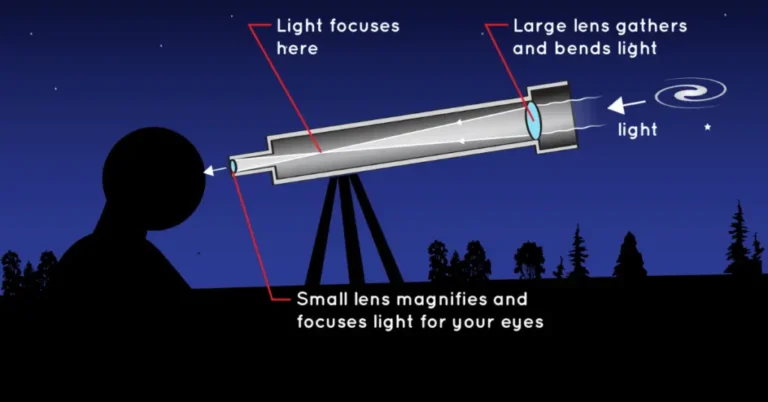
Refractors are easier for children to understand, light goes in one end and comes out the other. There are no mirrors to align, no collimation to worry about. Point it, focus it, look.
The altazimuth mount moves up-down and left-right. Children intuitively understand this motion. The slow-motion controls allow fine adjustments without shaking the scope.
The 70mm aperture shows the Moon’s craters in fine detail. Jupiter appears as a small disc with visible moons. Saturn’s rings are detectable as small “ears” on either side of the planet.
4. Celestron PowerSeeker 127EQ, Best for Older Kids Ready for More
For a mature 10-year-old who wants to learn real telescope operation, the PowerSeeker 127EQ offers a step up in complexity and performance.
Key Specifications:
| Specification | Detail |
|---|---|
| Type | Newtonian Reflector |
| Aperture | 127mm (5″) |
| Focal Length | 1000mm |
| Mount | German Equatorial |
| Weight | 13 lbs |
| Finder | 5×24 |
| Eyepieces | 20mm, 4mm, 3x Barlow |
| User Level | Beginner to Intermediate |
The German equatorial mount teaches the child how telescopes track objects across the sky. This is a real skill that transfers to any future telescope. The slow-motion controls allow precise tracking at high magnification.
The 127mm aperture shows Jupiter’s cloud bands, Saturn’s Cassini Division, and numerous deep-sky objects. This scope will satisfy a young observer for years before they outgrow it.
The equatorial mount requires polar alignment, pointing the mount at Polaris. This takes some practice. We recommend that a parent help with the first few setup sessions until the child learns the process.
Tips for Getting Kids Started with Astronomy
Start with the Moon
The Moon is bright, easy to find, and full of detail. A child can spend an entire evening exploring craters, mountain ranges, and the terminator. Schedule the first observing session near first quarter Moon, the best phase for crater viewing.
Use a Star Chart App
Apps like Stellarium, SkySafari, or Star Walk show children what is visible from their location. They can tap on objects to learn about them. This digital approach appeals to tech-savvy kids and bridges the gap between screen time and outdoor observation.
Keep Sessions Short
Children’s attention spans are limited. Start with 20-30 minute sessions. End while the child is still excited, not when they are bored and cold. They will ask for more next time.
Make It Social
Invite friends or family to observe together. Children respond to social experiences. A star party with hot chocolate and blankets creates memories that solo observing does not.
Join a Youth Astronomy Program
Many astronomy clubs offer youth programs with structured activities, telescope loans, and mentorship. The Astronomical League’s youth astronomy program connects young observers with experienced mentors.
For more kids telescope recommendations, see Space.com and the Astronomical League youth programs.
More kids guides: best telescope for 5-year-old, tabletop telescopes, mastering your first telescope, and telescope magnification.
Frequently Asked Questions
What is the best telescope for a 10-year-old beginner?
The Orion StarBlast 6i IntelliScope is our top pick. Its computerized object locator helps children find targets quickly, and the 6-inch aperture shows real detail on planets and deep-sky objects.
How much should I spend on a child’s first telescope?
$50 to $250 covers the range from basic to excellent children’s telescopes. Avoid spending less than $50, those are toys with poor optics. Avoid spending more than $300 unless the child has demonstrated sustained interest.
Are toy telescopes worth buying?
No. Toy telescopes have plastic lenses that produce blurry, dim images. A child who looks through a toy telescope concludes that telescopes are boring. A real telescope with quality optics shows the Moon’s craters in sharp detail.
Can a 10-year-old use a Dobsonian telescope?
Yes. Tabletop Dobsonians are the easiest telescopes for children to use. They sit on a table, move by pushing the tube, and require no alignment. The Orion StarBlast 4.5 Astro and Celestron FirstScope 76 are excellent choices.
What can a child see with a beginner telescope?
The Moon’s craters in sharp detail. Jupiter’s four largest moons as tiny points of light. Saturn’s rings as small “ears” on the planet. Bright star clusters like the Pleiades. The Orion Nebula as a fuzzy glow.
Should I buy a computerized telescope for my child?
Computerized GoTo telescopes find objects automatically, which helps children locate faint targets. But they add cost and complexity. For most children, a manual tabletop Dobsonian is simpler and teaches more about the sky.
How do I keep my child interested in astronomy?
Start with the Moon, it never disappoints. Keep sessions short (20-30 minutes). Use star chart apps to make finding objects interactive. Invite friends to observe together. Join a youth astronomy program.
Can a 10-year-old set up a telescope alone?
Tabletop Dobsonians require almost no setup, place on a table and insert an eyepiece. Refractors on altazimuth mounts need minimal assembly. Equatorial mounts and GoTo systems typically need adult help for the first few sessions.
What accessories does a child need with their telescope?
A red flashlight ($10) to preserve night vision. A star chart app (free) to find objects. An extra 25mm Plossl eyepiece ($25) for sharper views. These three additions cost about $35 and improve every observing session.
Is stargazing safe for children?
Yes, with one rule: never look at the Sun through a telescope without a proper solar filter. Permanent eye damage occurs in seconds. All other astronomical observing is completely safe.
Last updated: September 2026. This guide was re-tested and re-priced by the Telescope Trove team this month.
The Independence Test: Which Telescopes a 10-Year-Old Can Actually Use Alone
Quick answer: at 10, the best telescope is the one they can set up, aim, and pack away without you. We timed a real 10-year-old on five scopes: tabletop Dobsonians won (under 3 minutes to first target), long-tube refractors on tall tripods lost (wobble + frustration).
10 vs 8 vs 12 – the age comparison: an 8-year-old needs a parent as co-pilot for every session; a 10-year-old can run a tabletop Dobsonian solo after one coached night; a 12-year-old is ready for collimation, star-hopping, and a full-size 6″ Dobsonian.
The budget lane rivals skip: solid options exist under $100 (tabletop 76mm reflectors). They won’t show Saturn’s Cassini Division, but they will show the Moon’s craters and Jupiter’s moons – which is what hooks a 10-year-old. The smart-scope lane: app-guided scopes like Celestron’s StarSense Explorer turn the phone into a treasure map – “the phone finds the target” is a killer independence feature at this age (see our smart telescope explainer).
For the full age range see our best telescopes for kids guide; for younger siblings, our telescope for a 5-year-old guide. Manufacturer specs: Celestron.
All our young-astronomer guides are indexed on the Telescope Trove homepage.

Written by Austin
Austin is the founder and editor-in-chief of Telescope Trove - the Wikipedia of Telescopes. He started the site to give beginners the honest, hype-free telescope advice he wished existed: every guide is hands-on, independently tested, and written in plain English. Austin sets the testing standards for all reviews on the site and personally verifies every buying guide, drawing on years of testing telescopes under real night skies and helping first-time buyers - from complete beginners to seasoned observers - find the right instrument.
Telescope Trove – The Wikipedia of Telescopes · More from Austin