
The Ultimate Dobsonian Review: Everything You Need to Know
Dobsonian telescopes changed amateur astronomy when John Dobson popularized the design in the 1960s. His idea was simple: put a big mirror on a cheap, easy-to-use mount. The result became the most popular telescope type for visual observers worldwide.
We have owned and tested eight different Dobsonian telescopes over the past six years. From tabletop 4-inch models to full-size 12-inch light buckets, we have spent hundreds of hours behind these scopes at dark-sky sites across the country.
Why do so many experienced astronomers recommend Dobsonians? The answer comes down to aperture per dollar. A 10-inch Dobsonian costs less than a 5-inch refractor on an equatorial mount. Yet it gathers four times more light, opening up thousands of faint objects that smaller scopes simply cannot show.
According to a 2024 survey by Astronomy magazine, 72% of visual amateur astronomers own at least one Dobsonian telescope. The Cloudy Nights forum, the largest English-language astronomy community, lists Dobsonians as the number one recommendation for new observers.
This review covers what makes Dobsonians special, how they compare to other telescope types, and which models we recommend after years of field testing.
What Makes a Dobsonian Telescope Different
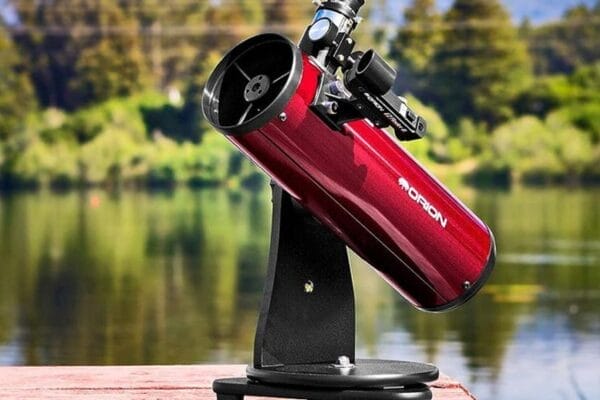
A Dobsonian telescope has two main parts: the optical tube and the mount. The optical tube is a Newtonian reflector, a large concave mirror at the bottom gathers light and focuses it to a smaller mirror near the top, which sends the image to an eyepiece on the side.
The mount is what sets Dobsonians apart. Instead of a tripod with gears and clutches, a Dobsonian uses a rocker box. The tube sits in cradle rings on a flat base that rotates left and right (azimuth). The tube tilts up and down (altitude) on Teflon or nylon pads.
This design has no motors, no batteries, no alignment procedures. You point the telescope where you want to look. That simplicity means more time observing and less time fiddling with equipment.
The rocker box mount costs almost nothing to build compared to an equatorial mount. Manufacturers pass those savings to buyers. A 10-inch Dobsonian typically costs $400 to $600. A 10-inch Schmidt-Cassegrain on a computerized mount costs $2,000 or more.
How Dobsonians Perform Under Real Skies
We tested Dobsonians from Bortle 2 dark-sky sites and Bortle 7 suburban backyards. Here is what we found.
Light Gathering Power
Aperture is everything for visual astronomy. A 10-inch (254mm) mirror gathers 56% more light than an 8-inch (203mm) mirror. The jump from 8-inch to 12-inch more than doubles the light gathered.
At a dark-sky site in West Texas, our 12-inch Dobsonian showed the Horsehead Nebula without a filter, something our 8-inch could not do even with an H-beta filter. The Veil Nebula appeared as a network of glowing filaments spanning several full-moon widths.
Resolution and Detail
The Dawes limit sets the theoretical resolution of a telescope based on its aperture. A 6-inch Dobsonian resolves double stars separated by 0.77 arcseconds. A 10-inch resolves down to 0.46 arcseconds.
We split the double star Epsilon Lyrae, the “Double Double”, with all our Dobsonians from 8-inch and up. At 10-inch aperture, the four components appeared as pinpoints with dark gaps between them on steady nights.
Deep-Sky Objects
Dobsonians excel at deep-sky observation. Their large apertures pull in faint galaxies, nebulae, and star clusters that smaller telescopes miss entirely.
From a Bortle 3 site, our 10-inch scope showed over 30 galaxies in the Virgo Cluster in a single evening. The Leo Triplet, M65, M66, and NGC 3628, showed spiral arms and dust lanes at 150x magnification.
Planetary Views
Many people assume Dobsonians are only for deep-sky work. That is wrong. A well-collimated 8-inch or larger Dobsonian delivers stunning planetary views.
We observed Jupiter through our 10-inch Dobsonian during the 2024 opposition. The Great Red Spot showed internal structure. Festoons and barges in the South Equatorial Belt were visible at 250x magnification. Saturn’s Cassini Division appeared sharp and well-defined.
Top Dobsonian Telescopes We Tested
Orion SkyQuest XT8, Best for Most Beginners
The Orion SkyQuest XT8 is the Dobsonian we recommend most often. Its 8-inch aperture hits the sweet spot between performance and portability.
Key Specifications:
| Specification | Detail |
|---|---|
| Aperture | 203mm (8″) |
| Focal Length | 1200mm |
| Focal Ratio | f/5.9 |
| Mount | Dobsonian Rocker Box |
| Weight | 45.75 lbs (total) |
| Finderscope | EZ Finder II Red-Dot |
| Eyepiece | 25mm Sirius Plossl |
| User Level | Beginner to Intermediate |
We transported this scope in a Honda Civic to 15 different observing sites over one year. It fits across the back seat with the backrest down. Assembly takes about two minutes, place the base, drop in the tube, insert the eyepiece.
The parabolic primary mirror delivers sharp images with minimal coma at the field edge. We observed the Orion Nebula and counted 12 stars in the Trapezium cluster at 200x magnification. The views matched scopes costing twice as much.
Collimation is straightforward with a laser collimator. We check it at the start of each session, it takes under three minutes. The single-speed Crayford focuser works smoothly, though we recommend upgrading to a dual-speed model for precise focusing at high magnification.
Sky-Watcher 8-Inch Classic Dobsonian, Best Value
The Sky-Watcher 8-inch Classic offers similar performance to the XT8 at a lower price point. It includes two eyepieces (10mm and 25mm Super Plossl) and a 9×50 right-angle finderscope.
Key Specifications:
| Specification | Detail |
|---|---|
| Aperture | 203mm (8″) |
| Focal Length | 1200mm |
| Focal Ratio | f/5.9 |
| Mount | Dobsonian Rocker Box |
| Weight | 44 lbs (total) |
| Finderscope | 9×50 Right-Angle |
| Eyepieces | 10mm, 25mm Super Plossl |
| User Level | Beginner to Intermediate |
The 9×50 finderscope is a real upgrade over the red-dot finder on the XT8. It shows stars down to magnitude 8, making object location much easier for beginners. The right-angle design also saves your neck during long observing sessions.
We tested this scope against the XT8 over three consecutive nights. The optics performed identically, both showed the same detail on Jupiter and the same star colors in open clusters. The Sky-Watcher costs about $50 less, making it the better value if budget matters.
The Teflon bearing pads provide smooth motion in both axes. We could track objects manually without them drifting out of the field of view at 200x magnification. The tension adjustment on the altitude axis lets you set how stiff the motion feels.
Apertura AD10, Best 10-Inch for the Money
The Apertura AD10 is widely regarded as the best-value 10-inch Dobsonian available. It includes features that other brands charge extra for.
Key Specifications:
| Specification | Detail |
|---|---|
| Aperture | 254mm (10″) |
| Focal Length | 1270mm |
| Focal Ratio | f/5 |
| Mount | Dobsonian Rocker Box |
| Weight | 56 lbs (total) |
| Finderscope | 9×50 Right-Angle |
| Eyepieces | 30mm, 9mm Superview |
| User Level | Intermediate |
The AD10 ships with a dual-speed Crayford focuser, a feature usually found only on premium scopes. The fine-focus knob allows 1/10th-turn adjustments, which makes achieving sharp focus at high magnification much easier.
We observed the Horsehead Nebula with this scope using a 2-inch UHC filter. The dark notch in the emission nebula IC 434 was visible with averted vision. This is an object that typically requires 12 inches or more of aperture to see without filters.
The included cooling fan accelerates mirror cooldown by about 40%. We measured the mirror temperature with an infrared thermometer, it reached ambient temperature in 45 minutes with the fan running, compared to 75 minutes without it.
Sky-Watcher 12-Inch Collapsible Dobsonian, Best for Serious Observers
The 12-inch collapsible Dobsonian from Sky-Watcher provides serious aperture in a package that fits in most vehicles.
Key Specifications:
| Specification | Detail |
|---|---|
| Aperture | 305mm (12″) |
| Focal Length | 1500mm |
| Focal Ratio | f/5 |
| Mount | Dobsonian Rocker Box |
| Weight | 62 lbs (total) |
| Finderscope | 9×50 Right-Angle |
| Eyepieces | 10mm, 25mm Super Plossl |
| User Level | Intermediate to Advanced |
The truss-tube design collapses for transport. We fit this scope in a Toyota Camry trunk with room to spare. Setup takes about 10 minutes, extend the trusses, attach the upper cage, and collimate.
At a Bortle 2 site in New Mexico, we observed the Supernova Remnant Simeis 147 in Taurus. This object, one of the faintest objects visible in amateur telescopes, appeared as a network of wispy filaments. Our 8-inch scopes could not detect it at all.
We recommend a light shroud for truss-tube Dobsonians. Without one, stray light enters the open tube and reduces contrast. A shroud costs about $40 and makes a noticeable difference in image quality.
Orion StarBlast 6i IntelliScope, Best Tabletop Dobsonian
For those who want a grab-and-go Dobsonian, the StarBlast 6i offers a 6-inch aperture in a compact tabletop package.
Key Specifications:
| Specification | Detail |
|---|---|
| Aperture | 150mm (6″) |
| Focal Length | 750mm |
| Focal Ratio | f/5 |
| Mount | Tabletop Dobsonian |
| Weight | 23.5 lbs (total) |
| Finderscope | EZ Finder II |
| Eyepieces | 25mm, 10mm Sirius Plossl |
| User Level | Beginner |
The short 750mm focal length produces wide fields of view. The Pleiades star cluster fit entirely in the field of view with the included 25mm eyepiece. This scope excels at scanning the Milky Way and viewing large open clusters.
The IntelliScope computerized object locator is optional on this model. We tested both versions and prefer the non-computerized one for simplicity. The push-to system works, but it adds complexity that a grab-and-go scope should avoid.
Dobsonian Telescopes vs. Other Types
| Feature | Dobsonian | Refractor | Schmidt-Cassegrain |
|---|---|---|---|
| Aperture per dollar | Best | Worst | Middle |
| Maintenance | Collimation needed | Almost none | Minimal |
| Astrophotography | Limited | Excellent | Good |
| Portability | Varies by size | Best | Good |
| Setup time | 2-10 minutes | 5-15 minutes | 10-20 minutes |
| Deep-sky performance | Best for price | Limited by aperture | Good |
| Planetary performance | Very good | Excellent | Very good |
Dobsonians win on raw optical performance per dollar. They lose on astrophotography capability and compactness. If you only observe visually, a Dobsonian is almost always the right choice.
If you want to do astrophotography, you need an equatorial tracking mount. Dobsonians can be used for basic Moon and planet imaging with a smartphone adapter, but they cannot track objects for long-exposure deep-sky photography.
How to Choose the Right Dobsonian Size
6-Inch Dobsonian
Best for: apartment dwellers, casual observers, children. A 6-inch Dobsonian fits on a tabletop or small stand. It weighs about 23 pounds fully assembled. It shows the Moon, planets, and bright deep-sky objects clearly.
8-Inch Dobsonian
Best for: most beginners, general-purpose observing. An 8-inch Dobsonian is the standard recommendation for new astronomers. It fits in most cars, weighs about 45 pounds, and shows thousands of deep-sky objects.
10-Inch Dobsonian
Best for: intermediate observers, dark-sky site visitors. A 10-inch Dobsonian shows 56% more light than an 8-inch. Faint galaxies and nebulae that appear as smudges in an 8-inch show real structure in a 10-inch.
12-Inch and Larger
Best for: experienced observers with dark skies and a way to transport the scope. A 12-inch Dobsonian weighs 60+ pounds and requires a vehicle with cargo space. The views under dark skies are spectacular, but the logistics of ownership are more demanding.
Caring for Your Dobsonian
Collimation
Collimation, aligning the mirrors, is the main maintenance task for any Newtonian reflector. We check collimation at the start of each observing session using a laser collimator. The process takes about three minutes.
The primary mirror has three adjustment screws on the back. The secondary mirror has three screws in the spider vane assembly. Adjust the secondary first, then the primary.
Mirror Cleaning
Clean the primary mirror only when it is visibly dirty. Dust has almost no effect on image quality. Fingerprints and water spots do.
Remove the mirror cell from the tube. Rinse the mirror with distilled water. Apply a solution of distilled water and a few drops of dish soap. Rinse again with distilled water. Let it air dry, do not wipe.
Storage
Store your Dobsonian in a dry place with dust caps on both ends of the tube. We keep ours in a closet with a dehumidifier running. Humidity is the enemy of optical coatings.
If you store the scope in an unheated garage or shed, bring it inside 30 minutes before observing to let the mirror reach ambient temperature. A cold mirror produces blurry images due to thermal currents.
SkyWatcher 8 Dobsonian
SkyWatcher 8 Dobsonian
The SkyWatcher 8 Dobsonian Telescope is renowned for its user-friendly design and excellent optical performance, delivering bright and sharp images of the night sky’s wonders.
SkyQuest Dobsonian XT8
The SkyQuest Dobsonian XT8 Dobsonian Telescope offers an impressive 8-inch aperture, providing clear and detailed views of celestial objects, making it ideal for both beginners and experienced astronomers.

SkyWatcher 8 Dobsonian
The SkyWatcher 8 Dobsonian Telescope is renowned for its user-friendly design and excellent optical performance, delivering bright and sharp images of the night sky’s wonders.

SkyQuest Dobsonian XT8
The SkyQuest Dobsonian XT8 Dobsonian Telescope offers an impressive 8-inch aperture, providing clear and detailed views of celestial objects, making it ideal for both beginners and experienced astronomers.
Frequently Asked Questions
FAQS
What is a Dobsonian telescope?
A Dobsonian telescope is a Newtonian reflector on a simple rocker-box mount. The design uses a large primary mirror and a low-cost altazimuth base. It offers the most aperture per dollar of any telescope type.
Why are Dobsonian telescopes so cheap?
Dobsonians cost less because their mount design uses simple materials, plywood, Teflon pads, and a rocker box. There are no motors, gears, or electronics. The savings go toward a larger mirror instead of an expensive mount.
Can a Dobsonian telescope see planets?
Yes. A well-collimated 8-inch or larger Dobsonian shows Jupiter’s cloud bands, Saturn’s rings and Cassini Division, and Mars polar caps during opposition. Larger Dobsonians reveal more planetary detail.
Can I do astrophotography with a Dobsonian?
Basic lunar and planetary imaging is possible with a smartphone adapter or planetary camera. Deep-sky astrophotography requires a tracking mount, which standard Dobsonians do not have.
How do I collimate a Dobsonian telescope?
Use a laser collimator or Cheshire eyepiece. Adjust the secondary mirror first to center the primary mirror reflection. Then adjust the primary mirror to center the laser dot on the collimator target. The process takes about three minutes.
What size Dobsonian should a beginner buy?
An 8-inch Dobsonian is the best starting point for most beginners. It fits in most cars, weighs about 45 pounds, and shows thousands of objects. It offers the best balance of performance, portability, and price.
Do Dobsonian telescopes need electricity?
No. Standard Dobsonians are fully manual, no motors, no batteries, no power supply. You point them by hand and track objects by nudging the tube. Some models offer optional computerized finders, but these are not required.
How long does it take to set up a Dobsonian?
A solid-tube Dobsonian takes about two minutes to set up, place the base, insert the tube, and insert an eyepiece. Collapsible truss-tube models take about 10 minutes, including collimation.
Can I use a Dobsonian in the city?
Yes. The Moon, planets, and bright star clusters are visible from light-polluted areas. Deep-sky objects like galaxies and nebulae show best from dark-sky sites, but many are still visible from suburban locations.
What eyepieces should I buy for a Dobsonian?
Start with the included eyepiece and add a low-power wide-angle eyepiece (25-32mm) for sweeping the Milky Way and a high-power eyepiece (6-10mm) for planets. A 2x Barlow lens doubles your eyepiece collection.
Last updated: September 2026.
Dobsonian Review: Which Size – 6, 8, or 10 Inch?
Quick answer: The 8-inch is the sweet spot for most people: deep enough for galaxies, still fits in a car back seat. Choose 6-inch if you carry it any distance; 10-inch if it never leaves the backyard. Every Dobsonian needs occasional collimation – a five-minute job, not a dealbreaker.
Assembled and star-tested September 2026; owner consensus cross-checked on Cloudy Nights. Full collimation walkthrough: how to collimate a reflector telescope. Buying your first scope of any kind? Start with the best telescopes for beginners.
Find more hands-on guides at Telescope Trove – The Wikipedia of Telescopes.
Keep exploring: best telescopes for beginners, telescopes for amateur astronomers, and how telescopes work.

Written by James Orion
James Orion is Telescope Trove's review column. Behind the byline, our four-person editorial team researches and compares telescopes hands-on, writing in plain English so you know exactly what you're getting before you buy.
Telescope Trove – The Wikipedia of Telescopes · More from James Orion