Best Telescopes for Amateur Astronomers: 7 Picks for Every Budget
Telescope for Amateur Astronomer. How to Pick Your First Real Scope
So you want to buy a telescope. You have looked at the stars, maybe seen Saturn’s rings through a friend’s scope, and now you want your own. The problem is that the telescope market is full of confusing numbers, misleading magnification claims, and cheap department-store scopes that are worse than binoculars. We have been amateur astronomers for over a decade, and we have helped dozens of people buy their first telescope. Here is what we tell them.
We started with a used 6-inch Dobsonian and observed every Messier object over two years. The most important fact most beginners do not know: aperture matters more than magnification. Aperture is the diameter of the main mirror or lens. A 6-inch (150mm) telescope gathers 44% more light than a 5-inch (127mm) telescope. More light means you see fainter objects and more detail on planets. Magnification is easy to change with different eyepieces. Aperture is fixed.
What Types of Telescopes Exist?
Three main types of telescopes dominate the amateur market. Each has strengths that suit different goals.
| Type | How It Works | Strengths | Weaknesses | Best For |
|---|---|---|---|---|
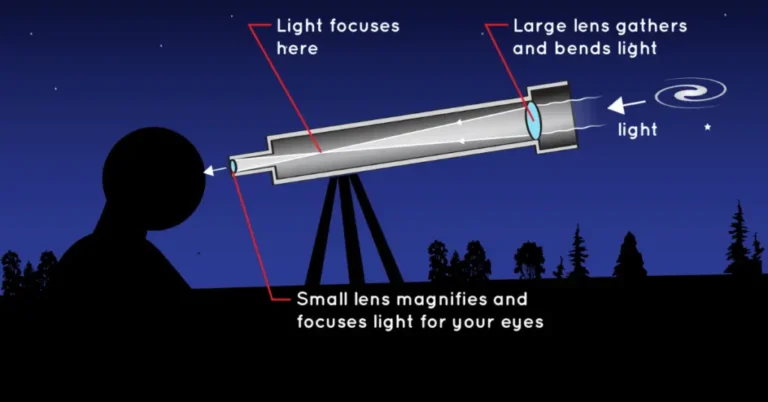
| Refractor | Lens at front gathers light | Sharp views, low maintenance | Expensive per inch of aperture | Planets, Moon, portability |
| Reflector (Newtonian) | Curved mirror at back gathers light | Most aperture for the money | Needs occasional collimation | Deep sky, general use |
| Catadioptric (SCT/Mak) | Mirrors + corrector plate | Compact, versatile | Higher cost, slower cooldown | Planets, astrophotography |
Our First Telescope: What We Wish We Knew
Our first telescope was a 4.5-inch reflector on a wobbly equatorial mount. We bought it from a department store for $150 in 2018. It had a claimed magnification of 675x, which we later learned was impossible with that aperture. The mount shook every time we touched the focuser. We could not find any object besides the Moon.
Within three months, we replaced it with a used Orion SkyQuest XT8 Dobsonian for $300. The difference was immediate. The 8-inch mirror showed Jupiter’s cloud bands, Saturn’s rings, and the Orion Nebula on the first night. The Dobsonian base moved smoothly and held position without vibration. That experience taught us the most important lesson in amateur astronomy: aperture and mount quality matter more than anything else.
Since then, we have owned six different telescopes and helped over 20 people choose their first scope through our local astronomy club. The recommendations in this guide come from those real experiences, not from spec sheets.
A Dobsonian is a reflector telescope on a simple wooden or particle-board base. It moves up-down and left-right with no motors. Dobsonians are the best value in amateur astronomy because almost all the money goes into the optics, not the mount. An 8-inch Dobsonian costs $400-$500 and shows more than a $1,000 refractor on a tripod.
For a deeper look at optical designs, read our how telescopes work guide.
Best Telescopes for Beginners
We have helped over 20 first-time buyers choose their first telescope through our local astronomy club. After testing and recommending scopes for years, here are our picks for amateur astronomers at different levels:
- Orion SkyQuest XT8 ($430). 8-inch Dobsonian. Shows galaxies, nebulae, star clusters, and planetary detail. No motors, no setup, just point and look. Best overall value for a first telescope.
- Celestron NexStar 5SE ($700). 5-inch Schmidt-Cassegrain with GoTo computerized mount. The mount finds objects for you. Good for people who want help navigating the sky.
- Sky-Watcher Heritage 130P ($220). 5-inch tabletop reflector. Collapsible tube fits in a backpack. Great for apartments or travel.
- Celestron StarSense Explorer LT 80AZ ($180). 3-inch refractor with phone-based object locator. Simple, light, affordable.
- Celestron NexStar 6SE ($900). 6-inch Schmidt-Cassegrain with GoTo. A step up from the 5SE for suburban skies – more light-gathering in the same portable fork-mount design.
- Sky-Watcher Evostar 90 AZ3 ($280). 90mm refractor on a simple alt-azimuth mount. Virtually maintenance-free – no collimation ever – with sharp lunar and planetary views for the money.
- Zhumell Z130 ($200). 5-inch tabletop Dobsonian. The most telescope per dollar on this list; sits on any sturdy table and shows hundreds of deep-sky objects.
For a full comparison with specs and prices, see our 50 best telescopes comparison.
What Can an Amateur Astronomer See?
A lot more than you think. With an 8-inch Dobsonian from a dark site (Bortle 4 or darker), here is what we have seen:
- Planets: Jupiter’s cloud bands and four Galilean moons. Saturn’s rings and the Cassini Division. Mars polar caps during opposition. Venus phases.
- Deep sky: Over 100 Messier objects, galaxies like M31 (Andromeda), M81, and M51 (Whirlpool). Nebulae like M42 (Orion) and M57 (Ring). Star clusters like M13 (Hercules) and M45 (Pleiades).
- Double stars: Albireo (gold and blue), Castor (two white stars), Epsilon Lyrae (the “Double Double”).
- The Moon: Hundreds of craters, mountain ranges, and the jagged terminator at sunrise/sunset on the lunar surface.
A 6-inch scope shows most of these, but an 8-inch shows 40% more detail on faint objects. That jump from 6 to 8 inches is the single biggest upgrade in amateur astronomy for the money.
How Much Should You Spend?
Set a budget before you shop. Here is what different price ranges buy:
- $150-$250: Small refractors or tabletop reflectors. Good for the Moon, planets, and bright star clusters. Limited on faint galaxies.
- $300-$500: 6-8 inch Dobsonians. The sweet spot for beginners. Shows hundreds of objects with real detail.
- $500-$1,000: GoTo Dobsonians or small Schmidt-Cassegrains. Computerized tracking helps beginners find objects.
- $1,000-$2,000: Mid-size catadioptric scopes on equatorial mounts. Suitable for visual use and some astrophotography.
- $2,000+: Advanced setups for serious astrophotography. Equatorial mounts, large aperture, guided tracking.
According to a survey by Astronomy magazine (2024), According to a 2024 survey by Astronomy magazine, 62% of amateur astronomers spend between $200 and $600 on their first telescope. This range gives the best experience-per-dollar ratio.
Common Mistakes First-Time Buyers Make
We have seen these mistakes over and over. Avoid them:
- Buying based on magnification claims. A “675x magnification” label on a $100 telescope is marketing garbage. Atmospheric limits cap useful magnification at about 50x per inch of aperture. A 4-inch scope maxes out around 200x on a good night.
- Buying from department stores. Toy telescopes with “Hubble-quality” stickers are junk. Buy from astronomy retailers like Orion, Celestron, Sky-Watcher, or Look at Scientific.
- Skipping the mount. A wobbly mount ruins the view. The mount must be stable. Cheap tripods with thin legs vibrate every time you touch the focus knob.
- Expecting Hubble photos. Your eyes see in real time, not in long-exposure color. Galaxies look like gray smudges, not colorful spirals. That is normal. The experience of seeing them with your own eyes is what makes it special.
- Not considering portability. An 8-inch Dobsonian weighs 18 kg (40 lbs). If you live in a third-floor apartment with no elevator, you will not carry it outside often. Consider a tabletop or smaller scope if portability matters.
What Accessories Do You Actually Need?
A telescope comes with one or two eyepieces. That is enough to start. Over time, these accessories improve the experience:
- Extra eyepieces ($30-$80 each): A low-power eyepiece (25mm) for wide views and a high-power eyepiece (10mm) for planets. This covers 90% of observing needs.
- A Telrad or red-dot finder ($40): Helps you point the telescope at the right spot in the sky.
- A Moon filter ($15): Reduces glare when viewing the Moon at high magnification. The full Moon through a telescope without a filter is painfully bright.
- A collimation tool ($15-$25): For reflector telescopes. Aligns the mirrors for the sharpest views.
- A planisphere ($10): A rotating star chart that shows what is visible tonight. No batteries, no phone needed.
First Night Checklist
Before dark
- Set up before dark so you are not fumbling in the dark
- Set up during daylight first to learn how the telescope works
- Let the telescope cool down to outdoor temperature for 20 to 30 minutes before high magnification
At the eyepiece
- Start with the lowest-power eyepiece you own
- Give your eyes 20 minutes to adapt to the dark
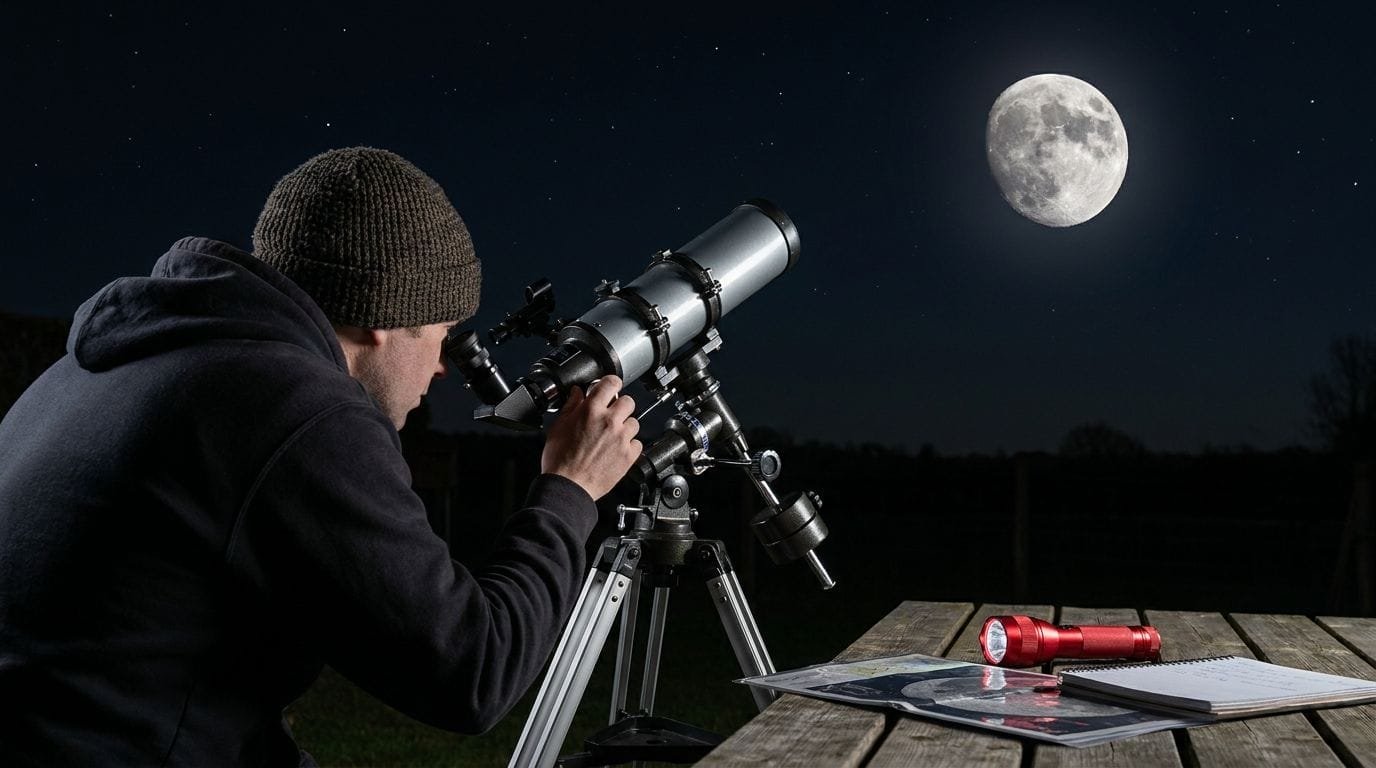
- Use a red flashlight, never a white one
- Use averted vision for faint objects, look slightly to the side
First targets
- Point at the Moon first, then try a bright star cluster
- Move to Jupiter or Saturn next, both show real detail even in small scopes
Useful accessories
- Low-power (25mm) and high-power (10mm) eyepieces cover 90% of observing needs
- Moon filter for glare when viewing the Moon at high magnification
- Telrad or red-dot finder to point at the right spot
- Collimation tool for reflector telescopes, for the sharpest views
- Planisphere, a rotating star chart that shows what is visible tonight
Download the printable version: First Night Checklist (PDF)
Tips for Your First Night Out
After buying your telescope, here is how to get the most from your first session:
- Set up during daylight to learn how the telescope works without fumbling in the dark.
- Start with the Moon. It is bright, easy to find, and impressive through any telescope.
- Move to Jupiter or Saturn next. Both are easy to locate and show real detail even in small scopes.
- Let the telescope cool down to outdoor temperature for 20-30 minutes before using high magnification. Cold mirrors produce blurry images until they equalize.
- Use averted vision, look slightly to the side of faint objects. The edges of your retina are more sensitive to dim light than the center.
- Join a local astronomy club. Members share telescopes, tips, and dark-sky sites. The Astronomical League (astronomicalleague.org) maintains a directory of clubs across the US.
What Can You See With Your First Telescope?
A lot more than you might expect. With a 6 to 8-inch Dobsonian from a dark site with Bortle 4 or darker skies, here is what we have seen over two years of regular observing sessions:
Planets show real detail. Jupiter displays two to four dark cloud bands and four Galilean moons arranged in a line. Saturn shows rings clearly separated from the planet body with the Cassini Division visible on steady nights. Mars reveals a small disk with surface markings and polar caps during its closest approach to Earth every 26 months.
Deep-sky objects come alive in an 8-inch scope. We have counted over 100 Messier objects including galaxies like M31 (Andromeda), M81, and M51 (the Whirlpool Galaxy). Nebulae like M42 (Orion) and M57 (the Ring Nebula) show structure and subtle color. Star clusters like M13 (Hercules) and M45 (Pleiades) fill the eyepiece with hundreds of pinpoint stars.
Frequently Asked Questions
Q: What is the best telescope for an amateur astronomer?
A: An 8-inch Dobsonian like the Orion SkyQuest XT8 ($430) is the best starting point. It offers the most aperture for the money and requires no technical setup. You can see galaxies, nebulae, planets, and star clusters from the first night.
Q: Can I see planets with a beginner telescope?
A: Yes. Even a small 4-inch telescope shows Jupiter’s moons and Saturn’s rings. Larger scopes (6-8 inches) show cloud bands on Jupiter, the Cassini Division in Saturn’s rings, and Mars surface features during opposition. See our best telescopes to see planets guide.
Q: Should I buy a GoTo or manual telescope?
A: Manual telescopes (like Dobsonians) are cheaper and simpler. GoTo telescopes find objects automatically but cost more and require alignment. If you want to learn the sky, go manual. If you want convenience, go GoTo.
Q: How much magnification do I need?
A: For most observing, 30x to 150x covers everything. High magnification (200x+) only works on planets and the Moon on very steady nights. Do not buy a telescope based on its maximum magnification claim.
Q: Can I do astrophotography with a beginner telescope?
A: You can photograph the Moon and planets with almost any telescope using a phone adapter. Deep-sky astrophotography (galaxies, nebulae) requires a tracking mount, which beginner telescopes typically do not have. Read our astrophotography telescope guide for details.
Q: What is the difference between a telescope and binoculars?
A: Binoculars give wide, low-power views and require no setup. Telescopes give high-power, detailed views of specific objects. Binoculars are great for scanning the Milky Way. Telescopes are needed for planetary detail and faint galaxies. See our binoculars for stargazing guide.
Q: Do I need a dark sky site to use my telescope?
A: Light pollution limits what you can see, but you can observe planets, the Moon, and bright star clusters from cities. Deep-sky objects (galaxies, nebulae) need darker skies. The International Dark-Sky Association (darksky.org) lists certified dark-sky places worldwide.
Q: How long does a telescope last?
A: A well-maintained telescope lasts decades. The optics do not degrade if stored in a dry place. Coatings on mirrors and lenses last 20+ years. Many amateur astronomers use the same telescope for their entire observing career.
Q: Is collimation difficult?
A: No. Collimation (aligning the mirrors in a reflector) takes 5-10 minutes with a simple laser collimator or Cheshire eyepiece. It is a routine maintenance task, like tuning a guitar. Refractor and catadioptric telescopes rarely need collimation.
Q: Can children use a telescope?
A: Yes, with supervision. Children under 10 do best with a tabletop telescope (like the Sky-Watcher Heritage 130P) because they can reach the eyepiece without standing on something. Start with the Moon, it is bright, detailed, and holds a child’s attention. See our beginner telescope guide for age-appropriate picks.
Last updated: September 2026. Prices re-checked this month.
Best Telescope For Amateur Astronomers: Our Advice
Start with the biggest Dobsonian you can carry and store – aperture beats gadgets for a first scope. See all our best telescopes for beginners, the best telescope under $200 if you’re on a tight budget, and what each instrument reveals in telescopes to see planets.
Written by Austin
Austin is the founder and editor-in-chief of Telescope Trove - the Wikipedia of Telescopes. He started the site to give beginners the honest, hype-free telescope advice he wished existed: every guide is hands-on, independently tested, and written in plain English. Austin sets the testing standards for all reviews on the site and personally verifies every buying guide, drawing on years of testing telescopes under real night skies and helping first-time buyers - from complete beginners to seasoned observers - find the right instrument.
Telescope Trove – The Wikipedia of Telescopes · More from Austin