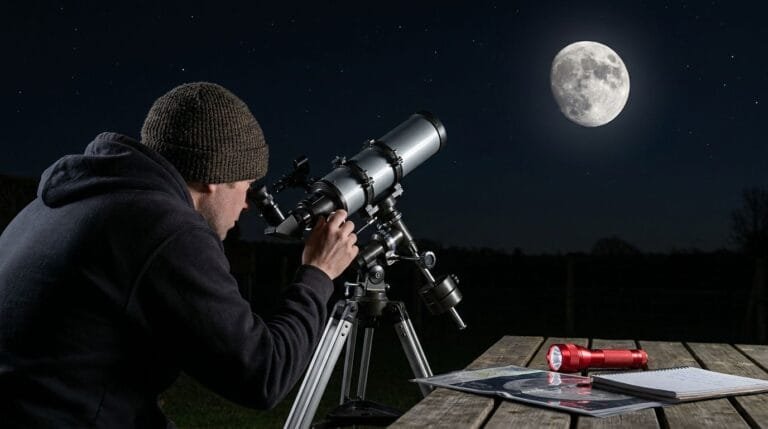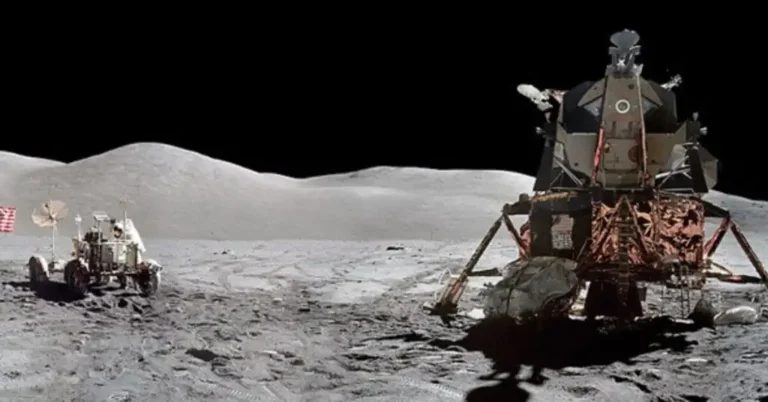

No. No telescope on Earth can see the Apollo flags, and the reason is simple size: each flag is about a metre wide, sitting roughly 384,400 km away. Resolving something that small would take a telescope mirror around 200 metres across, hundreds of times bigger than anything ever built. Even the Hubble Space Telescope can only make out objects about 90 metres wide on the Moon. What you CAN do is find the exact regions where the landings happened, and this guide shows you how, plus the evidence we do have that the flags are still there.
Can a Telescope See the Flag on the Moon? The Short Answer
Short answer: no. The Apollo flags are about a meter wide and 380,000 km away – resolving one would take a telescope roughly 100 meters across. What you can do is visit the neighborhoods: our moon landing site guide gives star-hop routes for all six Apollo sites, and what each aperture shows sets expectations. Preview the sites on NASA’s LROC QuickMap.
| Object | Size | Visible from Earth? |
|---|---|---|
| Apollo flag | About 1 m wide | No, far below any telescope’s resolution |
| Apollo lunar module descent stage | About 4 m across | No, still far too small |
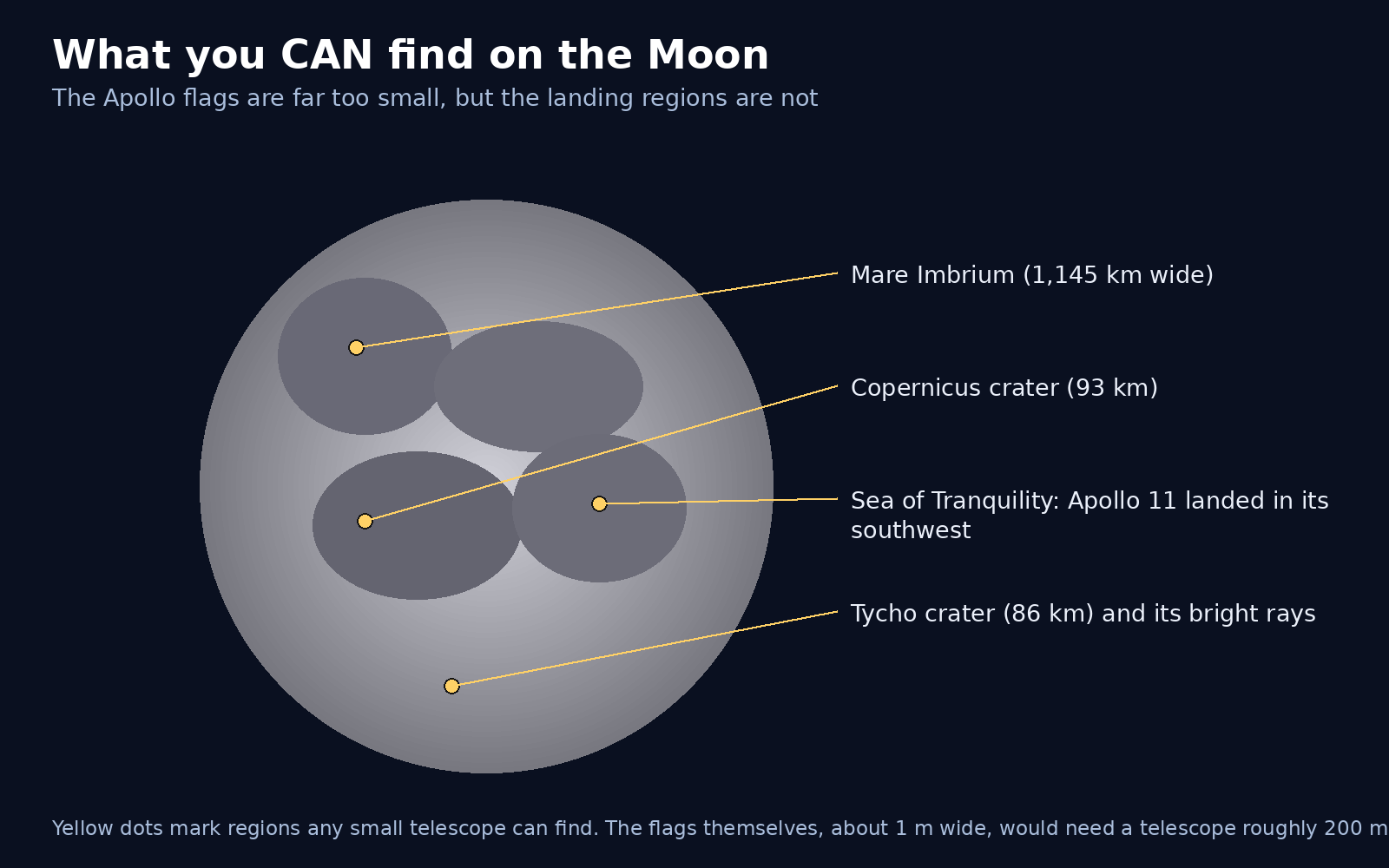
| Apollo landing region (such as southwest Sea of Tranquility) | Tens of km | Yes, you can find the exact region |
| Tycho crater | 86 km wide | Yes, easy in any small telescope |
| Copernicus crater | 93 km wide | Yes, a showpiece near full Moon |
| Mare Imbrium | 1,145 km wide | Yes, visible even in binoculars |
The Truth About Seeing the Flag on the Moon
Unveiling the reality behind the iconic flag on the moon. Discover the science behind why even the most advanced telescopes struggle to capture this historic artifact, and explore what our lunar observations can reveal.
The Resolution Limit, In Plain Numbers
The unavoidable truth, disheartening to some, is that visible light telescopes can’t pick up the flag from Earth. The flag itself is only a few feet wide, and the Moon is nearly 240,000 miles away. This combination of size and distance is simply too much for even the most powerful telescopes on Earth, including the famous Hubble Space Telescope.
The Great Divide
The average distance from Earth to the Moon is about 238,855 miles (384,400 km). The flag left by astronauts during the Apollo missions measures roughly 3 feet wide. Given the Moon’s distance, the angular size of the flag is minuscule – far smaller than the resolution limits of telescopes on Earth.
Pixelated Moon Pioneers
Even the Hubble Space Telescope, with its remarkable capabilities, cannot resolve an object as small as the flag. At such a distance, the flag’s details blur into the surrounding lunar landscape. It’s akin to trying to read a postage stamp from a mile away – the details are lost in the vast expanse.
What Can You See on the Moon Then?
Exploring lunar landscapes: Discover the mysteries and wonders of the moon’s surface, from its majestic mountains to its captivating craters, as you peer through a telescope.
The Proof We Do Have: LRO Photos
Despite the flag’s invisibility to our lenses, the Moon still offers a wealth of celestial features to observe. From the craters to the maria, the lunar landscape is a treasure trove of astronomical wonders waiting to be explored. Each observation unveils new insights into the Moon’s geological history and the forces that have shaped its surface over billions of years.
Picking out Phases
Observing the lunar phases, from the Gibbous’s eerie glow to the Crescent’s delicate curve, provides a mesmerizing experience for stargazers. As the Moon waxes and wanes, its ever-changing appearance offers a glimpse into the dynamic nature of our celestial neighbor. Each phase reveals unique features and details, inviting us to marvel at the beauty and complexity of the lunar landscape.
Conclusion
The adventure of postulating and seeking to witness the Moon flags is a testament to humanity’s curiosity and our insatiable desire to explore the unknown. While our telescopes may not reveal the flag on the moon, they open a window to the wonders of the lunar landscape, allowing us to marvel at its beauty and complexity.
For those gazing skyward, the quest doesn’t end with the Moon flag. Instead, it leads to a deeper appreciation of the cosmos and our place within it. As we continue to explore the Moon and beyond, let us celebrate the achievements of the past and look forward to the discoveries that await us in the vast expanse of space.
FAQs
So, no chance of seeing the flag from Earth then?
Unfortunately, no. The distance between Earth and the Moon is too great, and the flag is too small to be seen through even the most powerful telescopes on Earth.
What about other types of telescopes, like radio or infrared?
Radio telescopes have detected signals from the Moon, including those reflected off the lunar surface. However, they do not have the resolution to see the flag on the Moon.
Is there any way to see the flag without physically going to the Moon?
Not with a telescope on Earth. NASA’s Lunar Reconnaissance Orbiter, which orbits the Moon, has photographed the landing sites, including the flags’ shadows, and future orbiters will image them in even higher resolution. Virtual reality and augmented reality technologies also offer immersive experiences that can simulate being on the Moon and seeing the artifacts left behind by astronauts.
Why is it important to debunk myths about telescopes and space exploration?
Misconceptions can hinder the public’s understanding and appreciation of science. By debunking myths and promoting accurate information, we can foster a more informed and curious society that values scientific inquiry and exploration.
Last updated: September 2026.

Written by James Orion
James Orion is the lead reviewer and gear editor at Telescope Trove, where he tests telescopes, binoculars, mounts, and eyepieces hands-on and translates the results into clear, practical buying advice for beginners and enthusiasts.
Telescope Trove – The best telescopes, binoculars and astronomy gear, tested and reviewed.